- Home
- Insights
- CureLink and GDPR, HIPAA & KVKK: Why OR Integration Doesn't Have to Mean Compliance Risk
CureLink and GDPR, HIPAA & KVKK: Why OR Integration Doesn't Have to Mean Compliance Risk
When hospital procurement teams evaluate OR integration systems for connection to PACS, HIS, or surgical imaging infrastructure, one question consistently delays or complicates the process: does adding this system create new GDPR, HIPAA, or KVKK obligations? For most cloud-based OR platforms, the answer is yes. CureLink is designed so the answer is no — and the reason is architectural, not procedural.
The argument in one sentence
CureLink does not process or store patient data. It provides a secure interface to data that lives on your hospital's own servers — which means the compliance obligation stays exactly where it belongs: with the institution that controls the data, not the device in the OR.
What Hospital Procurement Teams Ask About OR Integration and Data Compliance
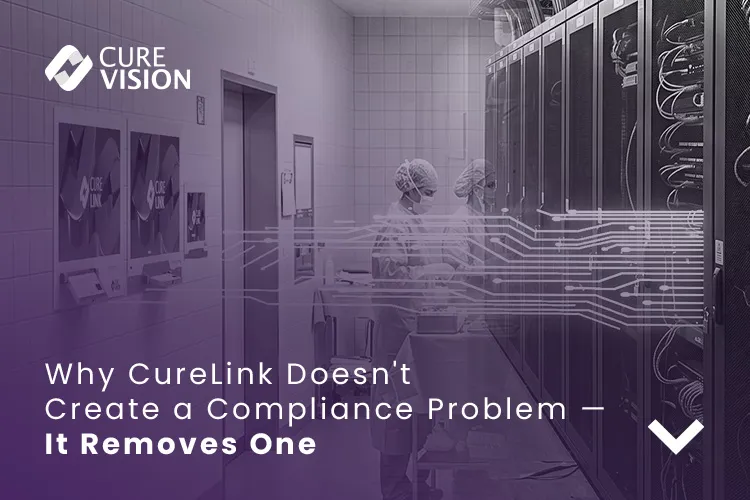
When hospital procurement teams evaluate OR integration systems, one concern comes up consistently: "If we connect this to our PACS and surgical environment, does it create a GDPR, KVKK, or HIPAA exposure?"
It is the right question to ask. Any system that transmits, processes, or stores protected health information becomes a data processor under these frameworks — and that creates documentation requirements, audit obligations, and shared liability for the institution.
CureLink is architected specifically to avoid this scenario. Understanding why requires a brief look at how data actually moves — or doesn't — in a CureLink deployment.
How CureLink handles data - The Architecture That Defines Its Regulatory Footprint
The distinction that defines CureLink's regulatory footprint is architectural, not procedural. It is not a policy choice. It is how the system is built.
Hospital server & data center
PACS images, surgical data, and all patient records remain on the hospital's own infrastructure at all times.
CureLink display & interface
CureLink provides a real-time access interface to that data inside the OR — it does not extract, copy, or re-process it.
Data boundary
Data does not leave the hospital environment. When remote collaboration occurs, it does so within the hospital's own controlled systems and consent framework.
This architecture has a direct regulatory consequence: because CureLink does not process or store personal health data, it does not become a data processor under GDPR, KVKK, or HIPAA. The compliance obligation — and the compliance infrastructure — remains with the hospital, where it already sits.
What this means for GDPR, KVKK, and HIPAA
Each of these frameworks is primarily concerned with systems that act as data processors or data controllers — entities that handle, transform, or store personal and sensitive health information. CureLink's design keeps it outside that definition.
GDPR (EU) — Regulation 2016/679
KVKK (TR) — Law No. 6698 - Türkiye's Personal Data Protection Law
HIPAA (US) — 45 CFR Parts 160 & 164
The practical result for your institution
Deploying CureLink does not require your institution to:
In practical terms: your compliance team's workload does not increase because of CureLink. Your hospital's existing data governance infrastructure covers the data. CureLink stays within it.
CureLink vs. cloud-based OR platforms - the key difference
Consideration
Cloud-based OR platforms
CureLink
Data location
External cloud servers, often multi-region
Hospital's own servers & data center
Data processing
Vendor processes data independently
No independent processing — interface only
GDPR / KVKK status
Vendor = data processor → DPA required
Hospital remains sole controller → no new DPA
HIPAA status
Vendor = Business Associate → BAA required
No BAA required — PHI stays with hospital
Data leaving hospital
Yes — by design
No — by design
Compliance burden added
Additional documentation
No additional burden
What this means for procurement and compliance teams
When evaluating OR integration platforms, the compliance question is not just "does this vendor claim to be compliant?" — it is "does adding this vendor to our environment create new obligations?"
With cloud-based systems, the answer is almost always yes: new data processing agreements, new audit scope, new vendor risk assessments. With CureLink, the architecture eliminates this category of concern. The data stays where it is. The compliance framework your institution already has in place continues to govern it.
For hospital procurement teams working across EU, Türkiye, and US regulatory environments — simultaneously — this is a meaningful operational advantage. One less vendor in your data processing chain. One less agreement to maintain. One less audit scope to manage.
That is not a compliance claim. It is a design choice — and it was intentional.
This article is provided for informational purposes only and does not constitute legal advice. Regulatory obligations vary by jurisdiction and institutional context. CureVision recommends that institutions consult qualified legal and compliance professionals when evaluating their specific regulatory requirements. The architectural descriptions above reflect CureLink's standard deployment model — institutions should confirm specific implementation details with CureVision's technical team.